The Microsoft AI Tour in Sydney did not feel like a day about a single product, a single model, or even a single category of use case. It felt like a guided journey through the questions organisations now have to answer if they want AI to become real, useful, and sustainable.
Across the sessions I attended on Thursday, April 23, 2026, at ICC Sydney, one theme kept resurfacing: the AI conversation has moved on from fascination to responsibility. The interesting question is no longer whether AI can do impressive things. The more useful question is how to turn AI into something operational, trusted, and valuable inside real organisations.
That is what made the day compelling. Each session added a new layer. The early talks showed where AI can matter at a human level. The keynote expanded that into a national and business transformation story. The middle of the day focused on agents, apps, and real operational workflows. The final sessions brought in the hard edges: security, governance, control, and scale.
1. AI Starts With Human Outcomes
The day opened in healthcare, and that was an unexpectedly strong way to begin. Rather than starting with infrastructure or model benchmarks, the first talks started with people.
When Every Human Has a Personal Health AI
Presenter: Rania Awad, Chief Strategy Officer, Helfie.AI
Rania Awad’s session framed AI as something much closer to a continuous companion than a one-off tool. The idea of a personal health AI suggested a shift away from reactive care and toward ongoing interpretation, intervention, and prevention. That was an important tone setter. It reminded me that the real promise of AI is not just automation, but the possibility of earlier understanding and better decisions.
AI for better health
Presenters: Kim Oosthuizen, Head of AI, Bupa; Alan Huynh, Account Technology Strategist, Microsoft
Kim Oosthuizen and Alan Huynh widened the lens. Their session made it clear that AI in healthcare is not only about one innovation or one feature. It depends on a broader foundation: vision, platform, responsible AI, delivery capability, and people who know how to use the technology in context.
One of the first strong lessons of the day came from here: becoming AI-first is not a tooling exercise. It is an organisational design exercise.
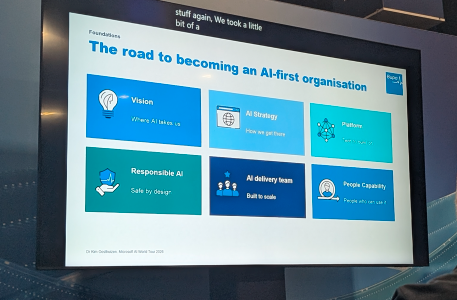
That slide captured the maturity model well. Vision, strategy, platform, responsible AI, delivery teams, and people capability all sit together. If one of those is weak, the transformation remains incomplete.
2. AI Has Become a National and Business Agenda
After the healthcare sessions, the mainstage keynote expanded the conversation. The focus moved from individual use cases to the wider shape of AI adoption in Australia.
Building Australia’s AI Frontier
Presenters: Vicki Brady, Chief Executive Officer, Telstra; Satya Nadella, Chairman and Chief Executive Officer, Microsoft; Anthony Miller, Chief Executive Officer, Westpac; Jane Livesey, President, Microsoft Australia & New Zealand
This session made AI feel immediate, local, and strategic. The strongest impression I took from it was that Microsoft was framing AI not simply as a technology wave, but as a productivity, workforce, and competitiveness issue for Australia.
The keynote reinforced three ideas:
- AI is now a business transformation topic, not a side innovation topic.
- Agents are emerging as a new layer in how work and systems will operate.
- Skills development is now part of national readiness, not just company-level enablement.
My photos from the keynote captured those ideas visually.
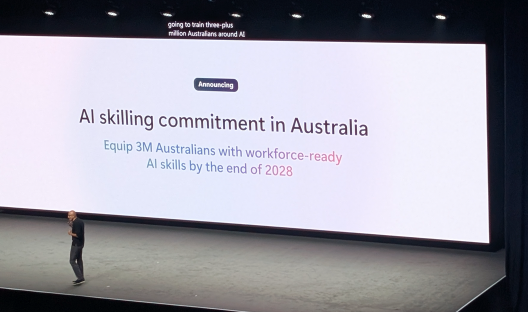
The keynote did something important for the rest of the day: it raised the ambition level. After that session, the later technical and operational talks felt less like isolated product sessions and more like answers to a much bigger question: what does it take to actually become a frontier organisation?
3. The Hard Part Is No Longer Possibility, It Is Execution
Once the keynote established the scale of the opportunity, the next group of talks became more grounded. The message was consistent: the bottleneck is no longer the existence of AI capability. The bottleneck is execution.
Overcome execution challenges in the era of frontier AI
Presenters: Ehsan Emamirad, SoftwareOne Australia; Ali Syed, Data & AI Executive, SoftwareOne Australia
Ehsan Emamirad and Ali Syed made the execution challenge explicit. Their session described AI adoption as a multi-layered problem shaped by data readiness, market maturity, change, and operational alignment. That mattered because it shifted the discussion away from capability theatre and toward delivery reality.
Becoming Frontier: Empowering AI adoption through skills development
Presenter: Christoper Gunawan, Chief Learning Officer, Microsoft
Christoper Gunawan returned to another theme that had already surfaced in the keynote: AI maturity depends on continuous learning. The value of the session was not just in saying that skills matter, but in showing that skill development has to be part of organisational culture, not a one-time rollout activity.
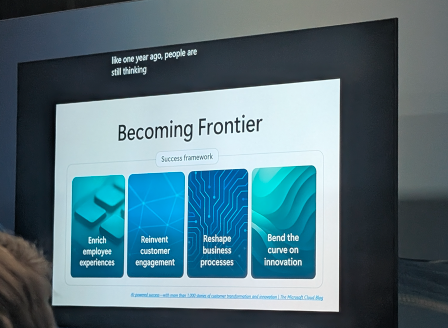
This reinforced a broader takeaway from the day: organisations do not become AI-capable just because a platform is available. They become AI-capable when their people can actually reason about the tools, adapt their workflows, and use AI with confidence.
4. Agents Are Becoming the New Application Layer
By late morning and early afternoon, the event started to focus more directly on agents and apps. This part of the day felt especially relevant because it connected the strategic vision to actual software, workflows, and developer experience.
Driving business innovation with AI apps and agents
Presenters: Joseph Reddy, AEMO; Marco Casalaina, VP Products and AI Futurist, Core AI, Microsoft
Joseph Reddy and Marco Casalaina presented AI apps and agents not as chat interfaces bolted onto existing systems, but as a new operational layer that can reshape workflows and decision-making. The examples suggested a future where agents sit across channels, tools, and systems rather than inside a single interface.
The most useful takeaway for me was that the value of an agent does not come from the model alone. It comes from the whole system around it:
- the tools it can access
- the business context it can understand
- the workflows it can support
- the controls that define what it is allowed to do
That image made the point clearly. Agents are extending into CLI, editors, web, mobile, and custom agent environments. This is not just an application feature. It is the beginning of a broader software pattern.
Cut through the hype and confront hard truths to scale agentic AI
Presenters: Peter Li, Partner, KPMG; Levi Watters, Partner, KPMG
This session was a useful counterweight. If the previous talks raised the energy around agents, this one added discipline. Peter Li and Levi Watters made the case that agentic AI should be approached with realism. That meant being selective about use cases, honest about failure modes, and careful about how fast organisations industrialise new patterns.
That was one of the most valuable balances in the whole event: ambition paired with restraint.
5. Copilots Become Valuable When They Understand Real Operations
The workshop on Azure Copilot and GitHub Copilot shifted the day from strategy into operational detail. This was one of the clearest examples of AI being used inside the flow of actual work.
Improving ops with Azure Copilot and GitHub Copilot
Presenter: Jorge Arteiro, Cloud Native Developer Advocate, Microsoft
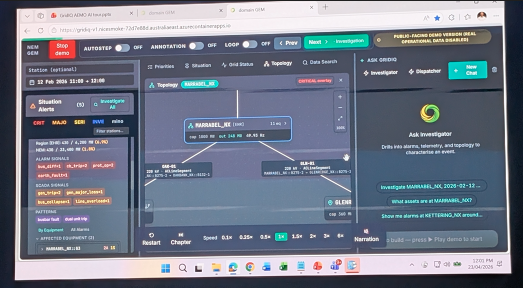
Jorge Arteiro’s workshop showed copilots in a setting that felt much closer to production reality. The examples in my photos referenced Azure resources, AKS clusters, deployment flows, resilience concerns, and investigation paths. This was not about vague productivity claims. It was about helping teams investigate, reason, and act inside live technical environments.
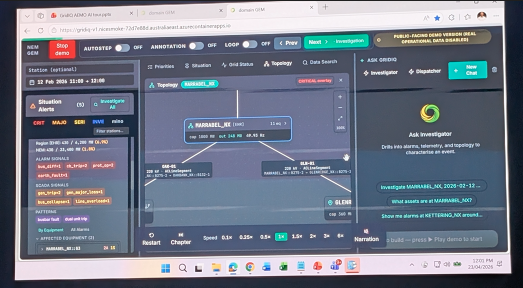
The lesson here was that copilots become meaningfully useful when they are grounded in operational context. Logs, topology, deployments, incidents, and architecture all matter. AI becomes more than an assistant when it can work with the same evidence and systems that operators and developers already use.
6. The More Useful Agents Become, the More Important Control Becomes
The strongest thematic finish to the day came from the security and governance sessions. By this point, the event had already shown the promise of apps, copilots, and agents. These final sessions answered the next question: what has to be true for any of this to scale safely?
Securing AI applications on Microsoft Foundry
Presenters: Gaby Hernandez, AI Security GBB, Microsoft; Jimena De Uria, Sr Security Go to Market Manager, Microsoft
This session made the risk landscape around AI far more tangible. The matching slide deck and the photos from the room highlighted the same message: once agents begin interacting with APIs, tools, prompts, internal systems, external systems, and data sources, the security surface expands dramatically.
The strongest takeaways were:
- agent sprawl is a real problem
- data oversharing is easy to create accidentally
- runtime behavior matters as much as build-time intent
- security and development teams need to work as one connected workflow
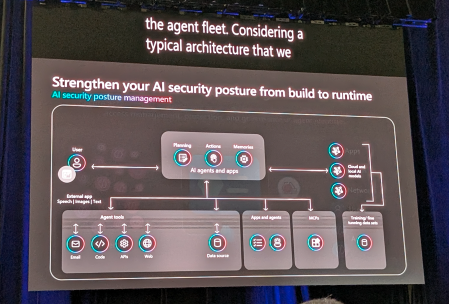
This session stood out because it did not frame security as a blocker. It framed security as part of what makes AI usable at enterprise scale.
Orchestrate action-oriented, context-aware agents with Microsoft Foundry
Presenter: Imogen Schifferle, Senior Product Manager AI and Agentic Apps, Microsoft
Imogen Schifferle’s session acted as a bridge between usefulness and control. Context-aware, action-oriented agents sound exciting, but the session made it clear that usefulness depends on design discipline. Agents need context, tools, permissions, and boundaries. Without that structure, “smart” can become brittle very quickly.
The takeaway here was that orchestration is not only a technical problem. It is also a product, security, and workflow design problem.
Microsoft Agent 365 Security & Governance Controls
Presenter: Shobhit Garg, Principal Product Manager, Microsoft
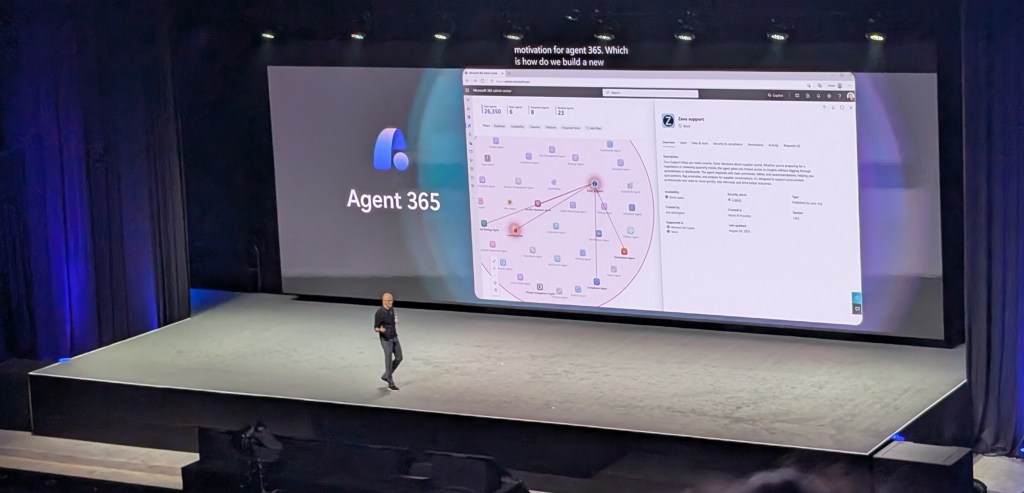
This final session pulled everything together. Shobhit Garg described Microsoft Agent 365 as a control plane for agents, extending familiar Microsoft capabilities in identity, management, visibility, security, and compliance to an agent estate.
The significance of this session was not just the product framing. It was the mindset behind it: if organisations are going to have large fleets of agents, then those agents need to be discoverable, governed, secured, and managed as first-class entities.
That image captured one of the clearest final lessons of the day. If the future includes a large population of agents, then governance has to scale with them. Otherwise, the same tools that create leverage also create risk.
7. What Stayed With Me Most
Looking back on the event as a whole, I think the biggest value of the day was not any single announcement or product message. It was the way the sessions connected into a coherent maturity journey.
Here is the path I saw:
First, AI has to matter to humans
The opening health sessions made the point that AI is valuable when it improves human outcomes, not when it simply demonstrates technical sophistication.
Second, AI has to become part of the business strategy
The keynote and customer stories showed that AI is now an organisational and national agenda, connected to investment, competitiveness, and workforce capability.
Third, AI has to be operationalised
The talks on execution, agents, and copilots showed that value emerges when AI is embedded into workflows, tools, systems, and decision processes.
Fourth, AI has to be governed
The final security sessions made it impossible to ignore that scale creates risk. The more capable and connected agents become, the more essential identity, observability, access control, compliance, and governance become.
Conclusion
What made the Microsoft AI Tour useful from my perspective was that it did not stay at the level of aspiration. It showed a progression from opportunity to implementation to control.
By the end of the day, the most important lesson for me was this: successful AI adoption is not about adding intelligence on top of existing systems and hoping value appears. It is about building the organisational conditions that let AI operate responsibly inside real work. That means vision, strategy, skills, workflows, platforms, security, and governance all have to mature together.
That is the learning journey I took away from the event. The story was not really about what happened hour by hour. It was about how each session added another answer to the same question: what does it actually take to move from AI enthusiasm to AI readiness?


 Diego Sanches Blog
Deixe um comentário